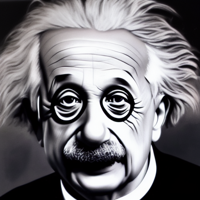

Albert Einstein
Albert Einstein, one of the most brilliant and influential scientists of all time, has left an indelible mark on our understanding of the universe. Born on March 14, 1879, in Ulm, Germany, Einstein's groundbreaking theories and profound insights have reshaped the field of physics and revolutionized our perception of space, time, and energy.
Einstein's theory of relativity, presented in his iconic papers in 1905 and 1915, redefined our understanding of the fundamental laws of the universe. The theory of special relativity introduced the concept of the speed of light as an absolute limit and demonstrated that time and space are not separate entities but intricately connected in what is now known as spacetime.
It challenged conventional notions of time and motion, giving rise to groundbreaking concepts like time dilation and the equivalence of mass and energy captured in the famous equation E=mc^2.
Einstein's theory of general relativity, published in 1915, went even further, proposing a new understanding of gravity as the curvature of spacetime caused by the presence of mass and energy.
Robert Oppenheimer

Robert Oppenheimer

born on April 22, 1904, in New York City, was a brilliant physicist who worked in the field of nuclear physics and leadership in the Manhattan Project.
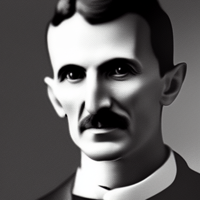
Nikola Tesla

Nikola Tesla

a visionary entrepreneur and philanthropist, has made an indelible impact on the world through his innovations and philanthropic endeavours.

Elon Musk

Elon Musk

is a visionary entrepreneur and innovator who has captivated the world with his bold ideas and pursuit of technological advancement.

This revolutionary theory provided a comprehensive framework for describing the behaviour of the cosmos on both cosmic and microscopic scales and laid the foundation for our modern understanding of black holes, the expanding universe, and the gravitational waves recently detected.
However, Einstein's contributions were not limited to theoretical physics.
While he had reservations about some aspects of quantum theory, his groundbreaking work on the photoelectric effect, for which he received the Nobel Prize in Physics in 1921, provided crucial empirical evidence supporting the quantized nature of light and paved the way for the development of the field of quantum mechanics.
Beyond his scientific accomplishments, Einstein's advocacy for peace, social justice and human rights has had a lasting impact. In the wake of World War I, he became an ardent proponent of disarmament and international cooperation. His involvement in various peace initiatives and passionate pleas for nuclear disarmament made him a global symbol of intellectual activism.
Einstein's genius was matched by his remarkable creativity and imagination. He possessed the ability to envision complex physical phenomena through thought experiments and visualizations. His capacity for abstract thinking, combined with his relentless curiosity, allowed him to challenge established paradigms and uncover the mysteries of the universe.
Despite his towering intellect, Einstein remained humble and approachable, displaying a deep sense of humanity and compassion. His life and work continue to inspire scientists, philosophers, and artists across disciplines, reminding us of the power of imagination, intellect, and curiosity in unraveling the secrets of the cosmos.
In conclusion, Albert Einstein's contributions to science, particularly in the realms of relativity and quantum mechanics, advocacy for peace and social justice adds to his legacy as a compassionate and influential figure in the realm of intellectual activism. His life and work stand as a testament to the power of human intellect, imagination, and the pursuit of knowledge.
Explore All